
Tires recycled since 1996
About the Programs
Nova Scotia’s used tire recycling programs help ensure tires are responsibly managed and recycled, supporting Nova Scotia’s commitment to waste diversion and environmental stewardship. Find out more and how to recycle your tires below.
Used Passenger Tire Program
Introduced in 1997 under Nova Scotia’s Solid Waste Resource Management Regulations, the Used Passenger Tire Program is operated by Divert NS and applies to end-of-life on-road passenger tires. When purchasing new tires for their motor vehicle, Nova Scotians pay a one-time environmental handling fee, which funds the program administration including collection and processing. Once the tires reach end of life, residents can return up to four regulated used passenger tires at a time to any participating tire retailer in the province for recycling, free of charge.
How to Recycle Your Tires
Simply take up to four used tires during business hours to any tire retailer in Nova Scotia for free. Tires must be:
- Whole
- Under 24.5 inches in diameter
- Off Rim
- Free of mud and debris
Accepted:
| Not Accepted:
|
Used Bicycle Tire Recycling Program
Launched in 2018 by Divert NS and free for both consumers and retailers, this voluntary program applies to all bicycle tires and tubes except tubular tires (which are glued to special rims). Nova Scotians can return their used bike tires and tubes to any of the registered drop-off locations.
How to Recycle Your Tires
Nova Scotians can return their used tires and tubes during regular business hours to any of the registered Drop-Off Locations. You can also recycle them when having new tires installed at any registered bicycle shop. Tires must be:
- Off rim
- Free of mud and debris
Got tires that aren't included?
Check out your municipality’s sorting guide for information on the proper disposal of non-program tires.
The Power of Recycling
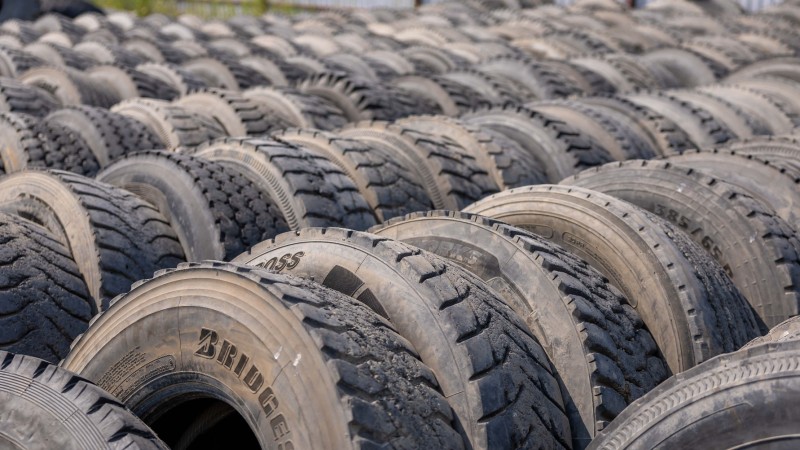
More than one million used tires are diverted from Nova Scotia’s landfills each year. This delivers measurable environmental and economic impact, including:
Rescues and preserves high-quality resources, extending the life of our landfills.
Drives meaningful reductions in greenhouse gas emissions.
Conserves energy and natural resources such as water and crude oil.
Creates jobs in the collection, transportation, and processing of used tires.
What Happens to Recycled Tires
70% of Nova Scotia’s used passenger tires are shipped to Halifax C&D Recycling in Goodwood where they are shredded into small pieces, known as tire derived aggregate (TDA), and used for drainage and filtration applications in traditional construction projects and, more recently, at wind farm sites, replacing traditional materials and reducing demand for newly extracted resources.
The provinces’ used bike tires (approximately 4,000 a year) are shipped to the Tire Recycling Atlantic Canada Corporation (TRACC) in Minto, New Brunswick. The valve stems are sold as brass scrap, and the tires and tubes are recycled into new molded rubber products, like cow mats.
The other 30% of end-of-life passenger tires are sent to Geocycle Canada- Lafarge Brookfield, where they are used to produce tire derived fuel (TDF), an alternative to coal in the cement making process. TDF is a proven, research-supported technology used globally, including in regions with the strictest emissions standards, and helps reduce reliance on fossil fuels.
See how tires get a second life
Local manufacturing of blasting mats
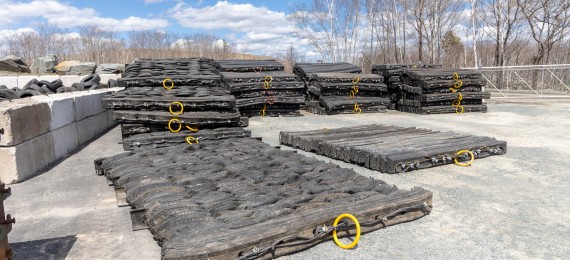
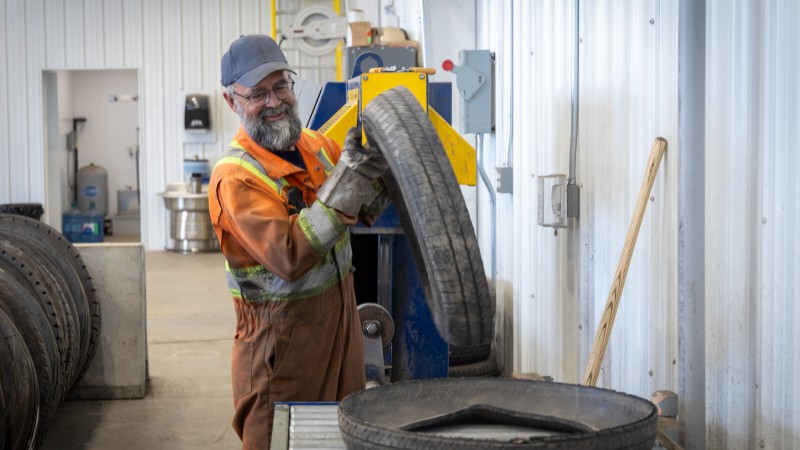
Building on its work with Nova Scotia’s recycled passenger tires, Halifax C&D established a manufacturing facility for blasting mats made from end-of-life highway truck tires. These mats are used in construction projects to contain debris and improve safety during blasting operations. Prior to this facility, blasting mats used in Atlantic Canada were sourced from outside the region, requiring transportation from central and western Canada.
Now produced locally, these mats not only create a new use for recycled tires but also help reduce transportation-related emissions by shortening supply chains. In 2025–26 alone, Halifax C&D used more than 1,100 tonnes of tires to produce approximately 350 blasting mats. The mats are distributed to customers across Atlantic Canada, demonstrating how locally developed solutions can have regional impact.
Have a use for end-of-life tires?
Divert NS continues to seek additional markets for our used tires. Where opportunities arise, we are able to direct up to 20% of total collection volume toward research and development projects. We also engage with smaller enterprises accessing a portion of this 20%, for example, a project splitting tires for farm silage cover, and another project using tires as wharf bumpers.
Environmental Handling Fee
The environmental handling fee charged depends on the size and type of tire purchased. The fees are as follows:
Tire Size and Type | Fee |
| All Passenger Tires and Light Truck Tires (including all on-road motorcycle, camper, and trailer tires) | $4.50/tire |
| Highway truck, tractor, and trailer tires not exceeding 24.5 inches | $13.50/tire |
For Tire Retailers and Salvage Yards
All retailers (regardless of location) are required to register with Divert NS before selling any regulated passenger tires in Nova Scotia. To register, please call 902-895-7732 or email info@divertns.ca.
For tire pickups, call:
- Mainland Nova Scotia, Cote Tire Junkie: (902)-890-1627
- Cape Breton, Maia Transport: (902)-295-0369